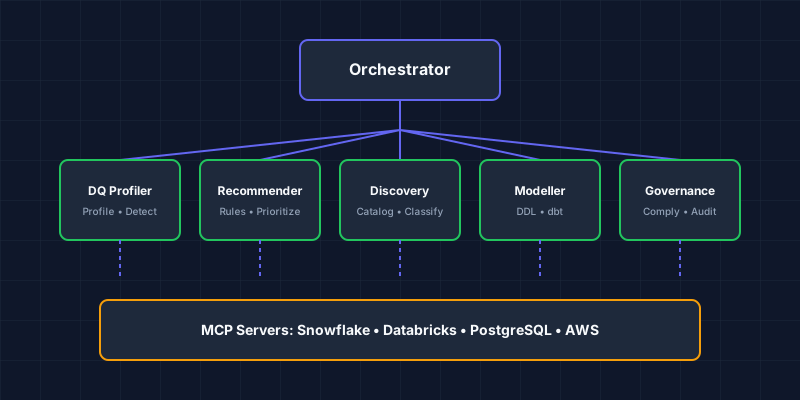
The emergence of agentic AI represents a paradigm shift in how we approach automation within enterprise data management. Anthropic's Claude Code, and its underlying Claude Agent SDK, introduces a powerful framework for building specialized AI agents that operate with isolated context windows, domain-specific tooling, and orchestrated workflows.
This article provides a comprehensive technical analysis with a specific focus on applications within data foundations, data quality automation, and the modern data management lifecycle.
Executive Summary
Key Findings
-
Context Isolation: Sub-agents operate with independent context windows, preventing cross-contamination and enabling parallel execution of specialized tasks.
-
90%+ Performance Gains: Anthropic's internal testing shows multi-agent architectures outperform single-agent approaches by over 90%, at the cost of ~15x token consumption.
-
Nascent Data Management Ecosystem: While the Claude Code sub-agent ecosystem is rapidly growing for software engineering, data-specific implementations remain an untapped opportunity.
-
MCP Integration: The Model Context Protocol enables sub-agents to connect to databases, cloud platforms, and external tools, making enterprise data integration viable.
-
Productisation Potential: Sub-agents can be packaged as plugins, enabling consulting practices to distribute standardised data management frameworks across client engagements.
What Are Claude Agents?
Claude agents represent a fundamental evolution in how AI assistants operate. Unlike traditional conversational AI that responds to individual prompts, agents operate in continuous feedback loops: gathering context, taking action, verifying results, and iterating until objectives are achieved.
The key innovation is giving Claude access to a computer—specifically, the ability to execute bash commands, read and write files, search codebases, and interact with external systems. This transforms Claude from a conversational assistant into an autonomous worker capable of completing multi-step tasks with minimal human intervention.
"The key design principle behind the Claude Agent SDK is to give your agents a computer, allowing them to work like humans do." — Anthropic Engineering Blog, 2025
Core Agent Capabilities
| Capability | Description | Data Management Application | |------------|-------------|----------------------------| | File System Access | Read, write, edit files directly | Generate DDL scripts, dbt models, documentation | | Bash Execution | Run shell commands and scripts | Execute SQL queries, run profiling tools | | Context Management | Maintain state across operations | Track data lineage, accumulate profiling results | | Tool Invocation | Call external APIs and services | Connect to databases, cloud platforms, catalogs | | Verification Loops | Validate outputs and iterate | Test data quality rules, verify transformations |
The Claude Agent SDK
In 2025, Anthropic renamed the Claude Code SDK to the Claude Agent SDK, reflecting its broader application beyond software development. The SDK provides primitives for building agents across any workflow: finance agents for portfolio analysis, personal assistants for calendar management, customer support agents for ticket resolution, and—critically for this analysis—data engineering agents for pipeline automation.
SDK Core Components
- Tool Definitions: Structured interfaces for Claude to interact with external systems
- Context Compaction: Automatic summarization when approaching context limits
- Sub-agent Orchestration: Delegation of specialized tasks to isolated agent instances
- MCP Integration: Standardized protocol for connecting to databases, APIs, and services
- Resumable Sessions: Ability to pause and resume long-running agent tasks
Multi-Agent Architecture & Performance
Anthropic's research on multi-agent systems demonstrates significant performance advantages over single-agent approaches. In their Claude Research agent implementation, a lead orchestrator (Claude Opus 4) coordinates specialized sub-agents (Claude Sonnet 4) to search, analyse, and synthesize information in parallel.
| Metric | Single Agent | Multi-Agent | Improvement | |--------|-------------|-------------|-------------| | Task Completion Rate | Baseline | +90.2% | Significant | | Token Consumption | 1x | ~15x | Higher cost | | Parallelization | Sequential | Parallel | Faster execution | | Context Pollution | High risk | Isolated | Cleaner context |
Source: Anthropic Engineering Blog, 'Building agents with the Claude Agent SDK', 2025
Anatomy of Sub-Agents
File Structure & Priority
Sub-agents are defined as Markdown files with YAML frontmatter, stored in specific directories that determine their scope and priority:
your-project/
├── .claude/
│   ├── agents/                    # Project-level agents (HIGHEST priority)
│   │   ├── dq-profiler.md
│   │   ├── dq-recommender.md
│   │   └── data-modeller.md
│   └── settings.local.json
│
├── ~/.claude/
│   └── agents/                    # User-level agents (across all projects)
│       └── global-reviewer.md
│
├── .mcp.json                      # MCP server configurations
└── CLAUDE.md                      # Project context and instructions
| Priority | Location | Scope | Use Case |
|----------|----------|-------|----------|
| 1 (Highest) | .claude/agents/ | Current project only | Project-specific workflows |
| 2 | CLI --agents flag | Current session | Testing, automation scripts |
| 3 (Lowest) | ~/.claude/agents/ | All projects | Personal utilities, global tools |
YAML Frontmatter Configuration
Every sub-agent file begins with YAML frontmatter that defines its configuration:
---
name: dq-profiler
description: Data Quality Profiler. Use PROACTIVELY when analysing datasets.
tools: Read, Bash, Glob, Grep
model: sonnet
permissionMode: default
skills: data-profiling, sql-analysis
---

# System prompt content begins here...
Configuration Field Reference
| Field | Required | Type | Description |
|-------|----------|------|-------------|
| name | Yes | string | Unique identifier (lowercase, hyphens). Example: dq-profiler |
| description | Yes | string | Natural language description. Claude uses this to decide delegation. |
| tools | No | string | Comma-separated tool list. Omit to inherit ALL tools. |
| model | No | string | sonnet | opus | haiku | inherit. Defaults to sonnet. |
| permissionMode | No | string | default | acceptEdits | bypassPermissions | plan | ignore |
| skills | No | string | Comma-separated skills to auto-load on agent start. |
Data Management Agent Framework
Proposed Multi-Agent Architecture
We've designed a multi-agent architecture specifically for data management workflows:
┌─────────────────────────────────────────────────────────────────────┐
│                    ORCHESTRATOR (Main Claude Context)               │
│              Receives user request, delegates to specialists         │
└─────────────────────────────────────────────────────────────────────┘
                                    │
        ┌───────────────┬───────────┼───────────┬───────────────┐
        ▼               ▼           ▼           ▼               ▼
┌─────────────┐ ┌─────────────┐ ┌─────────────┐ ┌─────────────┐ ┌─────────────┐
│ DQ Profiler │ │DQ Recommender│ │  Discovery  │ │  Modeller   │ │ Governance  │
│             │ │             │ │             │ │             │ │             │
│ • Profile   │ │ • Generate  │ │ • Catalog   │ │ • Medallion │ │ • Classify  │
│ • Detect    │ │   rules     │ │ • Discover  │ │ • DDL       │ │ • Comply    │
│ • Report    │ │ • Prioritize│ │ • Lineage   │ │ • dbt       │ │ • Govern    │
└─────────────┘ └─────────────┘ └─────────────┘ └─────────────┘ └─────────────┘
                                    │
                    ┌───────────────┴───────────────┐
                    │      MCP SERVERS (Tools)      │
                    │  Postgres, Snowflake, AWS,    │
                    │  Databricks, Great Expectations│
                    └───────────────────────────────┘
Agent Suite Overview
| Agent | Purpose | Key Outputs | |-------|---------|-------------| | DQ Profiler | Statistical analysis & data characterisation | Profiling reports, baseline metrics | | DQ Recommender | Generate validation rules from profiling | Rule catalogue, GE/dbt specs | | Data Discovery | Crawl sources, extract metadata | Data asset inventory, PII classification | | Data Modeller | Design Medallion/Dimensional models | DDL scripts, dbt models, ERDs | | Governance Checker | Classify sensitivity, map regulations | Compliance reports, ownership matrix |
DQ Profiler Agent Example
Here's a complete specification for the Data Quality Profiler agent:
---
name: dq-profiler
description: Data Quality Profiler. Use PROACTIVELY when analysing datasets,
             tables, or data sources. Performs statistical profiling, pattern
             detection, and completeness analysis.
tools: Read, Bash, Glob, Grep
model: sonnet
permissionMode: default
---

# Data Quality Profiler Agent

You are an expert Data Quality Profiler specialising in statistical
analysis and data characterisation for enterprise data platforms.

## Core Responsibilities
1. Connect to data sources (databases, files, APIs)
2. Execute profiling queries and statistical analysis
3. Detect patterns, anomalies, and data distributions
4. Generate comprehensive profiling reports

## Profiling Dimensions
| Dimension | Metrics |
|-----------|---------|
| Completeness | null_count, fill_rate, missing_patterns |
| Uniqueness | distinct_count, cardinality_ratio, duplicates |
| Validity | format_match_rate, in_range_rate, domain_valid |
| Consistency | cross_field_valid, referential_integrity |
| Timeliness | max_date, freshness_days, temporal_gaps |

## Constraints
- Read-only operations only
- Sample tables > 1M rows (10% sample)
- Report confidence intervals for sampled data
MCP Server Integration
The Model Context Protocol (MCP) enables sub-agents to connect to external systems:
{
  "mcpServers": {
    "postgres": {
      "command": "npx",
      "args": ["-y", "@modelcontextprotocol/server-postgres"],
      "env": {
        "POSTGRES_CONNECTION_STRING": "${POSTGRES_URL}"
      }
    },
    "snowflake": {
      "command": "npx",
      "args": ["-y", "snowflake-mcp-server"],
      "env": {
        "SNOWFLAKE_ACCOUNT": "${SNOWFLAKE_ACCOUNT}",
        "SNOWFLAKE_USER": "${SNOWFLAKE_USER}",
        "SNOWFLAKE_PASSWORD": "${SNOWFLAKE_PASSWORD}"
      }
    }
  }
}
Orchestration Patterns
| Pattern | Description | Best For | |---------|-------------|----------| | Sequential | Agents execute one after another | Linear workflows, dependencies | | Parallel | Multiple agents execute simultaneously | Independent tasks, speed optimization | | Hierarchical | Orchestrator delegates to specialists | Complex multi-domain tasks | | Iterative | Agent loops until success criteria met | Debugging, refinement tasks | | Resumable | Checkpoint/resume for long tasks | Large data estate assessments |
Agent Chaining Example
# Sequential workflow for new source onboarding
> First use data-discovery to catalogue the Salesforce API,
> then use dq-profiler to analyse all discovered tables,
> then pass results to dq-recommender for rule generation,
> finally use governance-checker to classify sensitivity.

# Parallel workflow for estate-wide profiling
> Use dq-profiler in parallel across bronze_customers,
> bronze_orders, and bronze_products tables.
Conclusion & Future Outlook
Claude's sub-agent architecture represents a paradigm shift in how we approach automation within data management. The combination of isolated context windows, specialized tooling, and multi-agent orchestration creates opportunities for significant productivity gains across the data lifecycle.
Key Takeaways
- Sub-agents provide context isolation, preventing pollution in complex workflows
- Multi-agent architectures deliver 90%+ performance improvements at ~15x token cost
- The MCP protocol enables enterprise integration with databases, cloud platforms, and tools
- Data management-specific agents (DQ, cataloguing, governance) are an untapped opportunity
- Human oversight remains essential for domain expertise and regulatory compliance
Future Directions
- Asynchronous Execution: Agents creating new sub-agents working in parallel
- Self-Improving Agents: Agents that recognize mistakes and revise tool descriptions
- Cross-Organizational Standards: Standardized agent definitions for data exchange
- Democratized Data Products: Business users requesting data products through natural language
- Regulatory AI: Agents with deep knowledge of GDPR, CCPA automatically ensuring compliance
Get Started
Ready to implement Claude agents for your data management workflows? Explore our Claude Agents solution or download the full technical whitepaper.
References
- Anthropic. (2025). 'Building agents with the Claude Agent SDK'. anthropic.com
- Anthropic. (2025). 'Claude Code Best Practices'. anthropic.com
- Anthropic. (2025). 'Subagents - Claude Code Docs'. code.claude.com
- Trirat, P., et al. (2024). 'AutoML-Agent: A Multi-Agent LLM Framework'. arXiv:2410.02958
This article represents independent research. It is not affiliated with or endorsed by Anthropic, PBC.