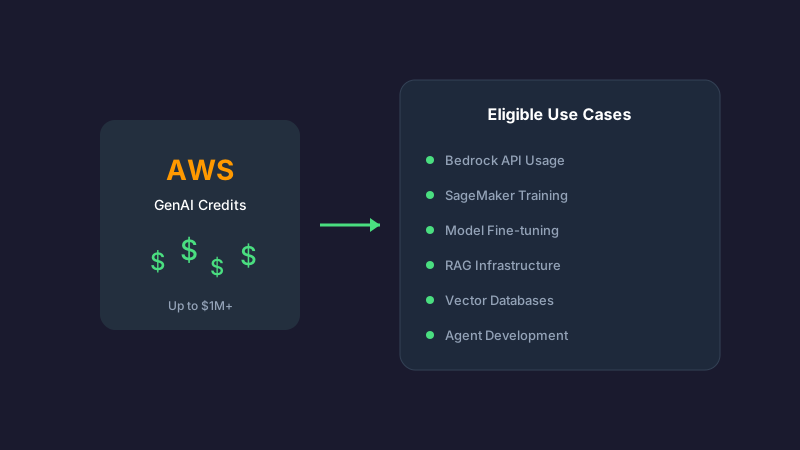
AWS has been aggressively funding GenAI initiatives through various credit programmes and incentives. If you're building on AWS, there's a good chance you're leaving money on the table.
We've helped several clients secure substantial AWS credits for their AI initiatives. Here's what we've learnt about navigating the landscape.
The Funding Landscape
AWS offers several mechanisms for funding GenAI work:
1. AWS Activate
Primarily for startups, AWS Activate offers:
- Up to $100,000 in credits for portfolio companies of participating VCs
- Up to $25,000 for self-funded startups
- Technical support and training
Eligibility
Your company must be a new AWS customer (under 2 years) and have received less than $10M in funding to qualify for the highest tier.
2. AWS Solution Provider Credits
If you're working with an AWS Partner (like Arc Horizon), you may qualify for:
- Proof-of-concept funding
- Migration credits
- GenAI experimentation credits
These are typically negotiated on a case-by-case basis through your partner.
3. Enterprise Discount Programme (EDP)
Large enterprises with significant AWS spend can negotiate:
- Committed spend discounts (typically 10-25%)
- Innovation credits for new workloads
- GenAI experimentation allowances
4. AWS GenAI Competency Partner Funding
AWS is actively funding GenAI projects through partners who hold the AWS GenAI Competency. Working with these partners can unlock:
- PoC funding (typically £25,000-100,000)
- Implementation credits
- Technical resources from AWS
How to Secure Funding
Step 1: Document Your Use Case
AWS wants to fund projects that:
- Demonstrate clear business value
- Showcase AWS services (especially Bedrock)
- Have potential for broader adoption
Prepare a one-page brief covering:
- Business problem being solved
- Technical approach (which AWS services)
- Expected outcomes and metrics
- Timeline and investment required
Step 2: Engage the Right AWS Team
Different teams control different budgets:
| Use Case | AWS Team | Typical Funding | |----------|----------|-----------------| | Startup PoC | Startup BD | £10-50k credits | | Enterprise pilot | Enterprise Account | £25-100k credits | | Partner-led project | Partner Team | Variable | | Large migration | Migration Team | £50-500k credits |
Your AWS account team can point you to the right programme.
Step 3: Demonstrate Bedrock Adoption
AWS is particularly keen to fund projects using Amazon Bedrock — their managed GenAI service. Projects using Bedrock typically get:
- Faster approval
- Larger credit amounts
- Additional technical support
If you're currently using OpenAI or another provider, consider how you might incorporate Bedrock for at least part of your solution.
Step 4: Show Commitment
AWS credits are an investment in future spend. They want to see:
- Long-term AWS commitment (multi-year EDPs help)
- Plans to expand usage after the pilot
- Reference-ability (willingness to do case studies)
Step 5: Leverage Your Partner
If you're working with an AWS Partner, they can:
- Access partner-specific funding pools
- Navigate internal AWS processes
- Provide references from similar projects
- Co-invest their own resources
Partners with GenAI Competency status typically have the best access to funding. Ask about their funding track record before engaging.
What Gets Funded
Based on our experience, these project types attract the most funding:
High-Probability Funding
- RAG implementations using Bedrock and OpenSearch
- Customer service automation with Bedrock agents
- Document processing using Textract + Bedrock
- Data quality automation using custom Bedrock applications
- Migration from OpenAI to Bedrock equivalents
Moderate-Probability Funding
- Custom model fine-tuning
- Multi-modal applications
- GenAI-enhanced analytics
- Internal productivity tools
Lower-Probability Funding
- Pure research without clear business application
- Projects using only third-party models (no AWS services)
- Already-completed projects seeking retroactive credits
Maximising Credit Value
Once you've secured credits, make them count:
1. Use Credits for Experimentation
Credits are perfect for:
- Testing multiple models to find the best fit
- Running A/B tests on prompts
- Building throwaway prototypes
- Training team members
Don't burn credits on production workloads that should be in your regular budget.
2. Track Usage Carefully
Credits typically have:
- Expiry dates (often 12 months)
- Service restrictions (some credits only apply to specific services)
- Minimum spend requirements (for EDP credits)
Set up billing alerts and regular reviews.
3. Document Everything
If the pilot succeeds, you'll want to:
- Demonstrate ROI to justify continued investment
- Create a case study for AWS (opens doors to more funding)
- Build internal support for scaling
Keep detailed records of what you tried, what worked, and what didn't.
Common Pitfalls
1. Not Asking
The number one reason companies don't get AWS funding is they don't ask. Every company we've helped assumed they wouldn't qualify — and most did.
2. Poor Timing
AWS fiscal year runs January-December. Budgets are often:
- Flush in Q1 (January-March)
- Tighter in Q4 (October-December)
Start conversations in Q4 for Q1 funding.
3. Vague Proposals
"We want to explore AI" doesn't get funded. "We want to build a Bedrock-powered document processing system that will reduce manual review time by 60%" does.
4. Ignoring the Partner Route
Direct engagement with AWS can work, but partners often have:
- Faster access to decision-makers
- Existing funding relationships
- Technical expertise to strengthen proposals
A Practical Example
Here's how we recently helped a client secure £75,000 in AWS credits:
The situation: A pharma company wanted to build a clinical document search system using RAG.
The approach:
- We partnered to design a Bedrock-based architecture
- Documented the use case with expected business outcomes
- Engaged AWS's healthcare team through our partner network
- Proposed a 12-week PoC with clear success metrics
The outcome: £75,000 in credits approved within 4 weeks, covering the full PoC infrastructure costs.
Conclusion
AWS is actively investing in GenAI adoption. If you're building on AWS, it's worth exploring what funding is available for your initiatives.
The key is preparation: clear use cases, AWS-native architectures (especially Bedrock), and the right partnerships to navigate the process.